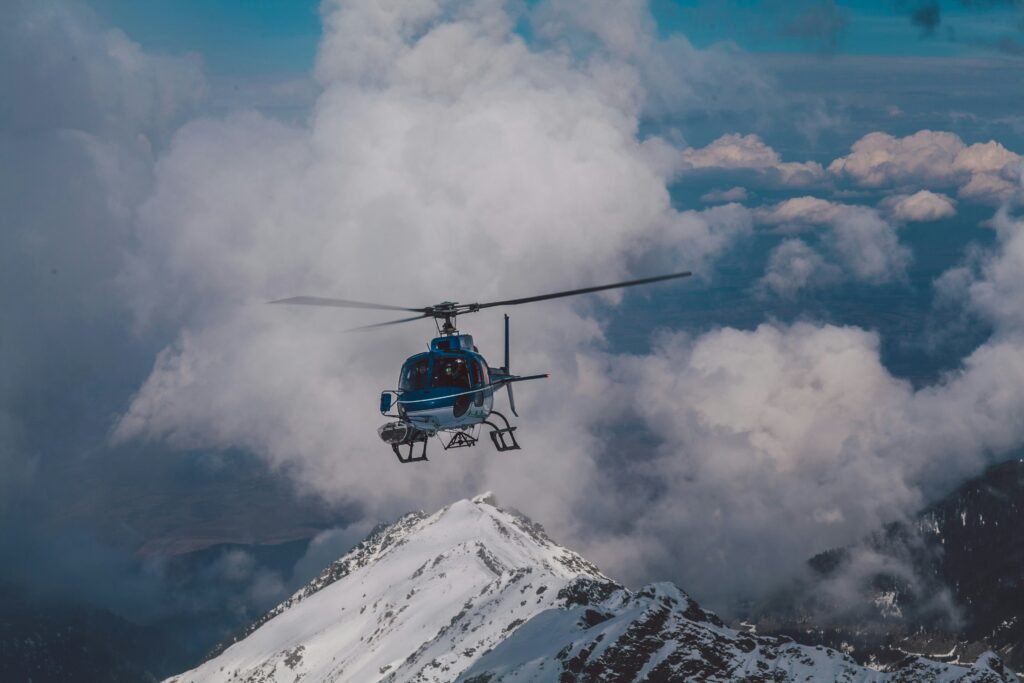
Helicopter charter can be useful for journeys where access, local geography or a short point-to-point transfer makes a rotary-wing aircraft worth considering. In India, each mission must be assessed for landing-site suitability, permissions, weather, aircraft performance and the operator’s procedures. A helicopter cannot simply land at any convenient open space.
When can helicopter charter be useful?
Regional and point-to-point transfers
A helicopter may connect locations that are difficult to reach efficiently by road, subject to approved landing arrangements. The benefit depends on the actual origin and destination, ground access and time needed for transfers.
Remote destinations and events
Helicopters may be considered for access to remote sites, business events, tourism or time-sensitive movements. Landing zones must be assessed and authorised as required, and ground teams may need to coordinate access and passenger handling.
Corporate and private travel
For executives or private groups, helicopter transfers can form one part of a wider itinerary, such as connecting an airport with a suitable destination. Allow time for road transfers, security procedures and weather-related schedule changes.
Planning a helicopter charter
- Define the mission: Share the origin, destination, date, passenger count and purpose of travel.
- Assess landing locations: Provide exact site details. The operator must assess dimensions, surface, obstacles, approach and departure paths, permissions and local restrictions.
- Confirm aircraft suitability: Passenger weight, baggage, altitude, temperature, route distance and fuel requirements affect the aircraft choice.
- Review weather and timing: Helicopter operations are weather-sensitive. The pilot and operator retain responsibility for go/no-go decisions.
- Coordinate ground arrangements: Confirm transfers, passenger briefing, access control and any local support needed.
Safety and operating considerations
Ask for the identity of the operating carrier, relevant approvals, aircraft details and the process for assessing landing sites. Confirm who makes operational decisions and how weather delays, diversions or cancellations are handled. Do not pressure a crew to operate when conditions are unsuitable. A proposed schedule remains subject to the pilot’s assessment and applicable regulations.
Passenger and baggage planning
Helicopter cabins and baggage compartments are often more constrained than those of larger fixed-wing aircraft. Provide accurate passenger weights when requested, the number and dimensions of bags, and any mobility or medical assistance needs. The operator will confirm the permissible load and seating arrangement.
What can affect availability and cost?
Aircraft positioning, flight time, waiting time, landing fees, site surveys, permissions, crew duty limits, fuel planning and weather contingencies may affect the proposal. Ask for inclusions, exclusions and cancellation terms in writing.
Frequently asked questions
Can a helicopter land at a hotel or private property?
Only if the site is suitable and all required permissions and operational approvals are in place. The operator must assess the location.
Can the flight operate in all weather?
No. Weather, visibility, wind and other conditions can affect whether a flight can proceed. The pilot’s decision is final.
How many passengers can travel?
Capacity depends on the helicopter model, cabin configuration, passenger weights, fuel and mission conditions. Confirm the exact payload with the operator.
Plan a helicopter transfer with RHJ Aviation
Share the locations, dates, passenger details and landing-site information for an initial assessment. Any proposed helicopter movement remains subject to operator availability, site approval, weather and regulatory requirements.